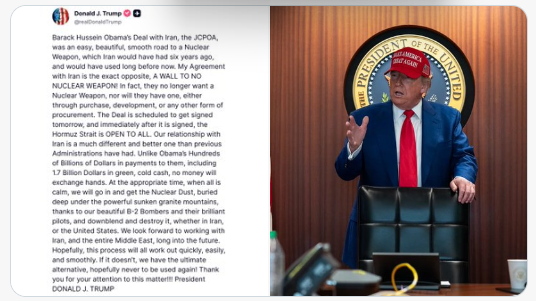
BREAKING: President Trump says a Peace Deal with Iran is scheduled to be signed TOMORROW. Iran will no longer be pursuing nuclear weapons, and the Strait of Hormuz will be open to all.
WASHINGTON D.C. — In an unprecedented geopolitical shift that has stunned the international community and reshaped the balance of power in the Middle East, the decades-long shadow of an Iran-US war appears to be finally dissipating. Following a series of highly secretive negotiations, a comprehensive peace treaty between the United States and the Islamic Republic of Iran is slated to be finalized and signed tomorrow.
This monumental agreement, heralded as the defining diplomatic achievement of 2026, promises to permanently halt Tehran’s controversial nuclear program. Equally critical to the global economy, the accord guarantees that the Strait of Hormuz—the world’s most vital maritime chokepoint—will remain unconditionally open to all global shipping traffic, effectively neutralizing a perennial flashpoint for international conflict.
The Diplomatic Breakthrough
The foundation for this historic June peace deal was laid quietly over several months, utilizing the trusted diplomatic channels of Switzerland, which has long served as the protecting power representing American interests in Tehran. The strategy involved intense, backdoor shuttle diplomacy, culminating in face-to-face meetings that began to surface in the press on June 12.
By the morning of June 13, the news was officially confirmed. President Donald Trump addressed the nation, declaring an end to the hostilities that have defined US-Iran relations for over four decades. “The risk of a catastrophic conflict is over,” the President stated. “America and the world are safer today.”
The Iranian delegation, led by veteran diplomat and Minister Abbas Araghchi, confirmed the parameters of the agreement shortly thereafter. Araghchi emphasized that Iran’s sovereign rights to peaceful civilian nuclear energy would be respected under strict international oversight, while unequivocally renouncing the pursuit of weaponization.
De-escalation and Military Withdrawal
For years, the specter of armed conflict has loomed large over the Persian Gulf. The region has been a testing ground for asymmetrical warfare, frequently plagued by the deployment of unmanned aerial vehicles targeting commercial vessels and regional infrastructure. The relentless tension forced the armed forces of multiple nations to maintain a constant, high-alert presence in the region’s contested waters and island territories.
With tomorrow’s scheduled signing on June 14, those military postures are set to drastically change. The agreement outlines a phased, mutual de-escalation protocol. The United States has committed to scaling back its naval strike groups in the immediate vicinity, while Iran has agreed to cease all hostile maneuvers, including the use of proxy drone strikes and fast-attack boat harassments in the shipping lanes.
This immediate reduction in military risk is a monumental relief for neighboring states. Israel, which has long viewed a nuclear-armed Iran as an existential threat, expressed cautious optimism. While Israeli defense officials are scrutinizing the enforcement mechanisms of the treaty, the immediate removal of the nuclear threat radically alters the security calculus in the Levant, particularly concerning Iranian support for militant factions in Lebanon.
The Strait of Hormuz: A Lifeline Restored
Perhaps the most immediate and tangible global impact of this US-Iran breakthrough is the guaranteed security of the Strait of Hormuz. Through this narrow waterway flows approximately one-fifth of the world’s total oil consumption. For decades, the threat of Iran mining or blockading the Strait served as a powerful, disruptive geopolitical leverage point.
Today’s latest update on the situation confirms that the Strait is fundamentally transformed from a militarized choke point into an open, secure corridor for international commerce. Shipping companies, which had been burdened by exorbitant war-risk insurance premiums and the necessity of armed escorts, are already forecasting massive operational savings. The world is finally open for uninterrupted, secure energy transit.
Maritime traffic control centers have reported a palpable shift in the atmosphere on the water. The constant state of high alert has been replaced by an orderly, secure flow of commercial vessels. This easing of tensions extends deeply into the region, stabilizing the economic outlook for neighboring Gulf states like Oman and Qatar, both of which played vital, behind-the-scenes roles in facilitating early dialogues and managing regional expectations.
Global Markets and the Petroleum Renaissance
The economic shockwaves of the announcement were immediate and profound. Across the globe, live oil prices plummeted on the news, reflecting the massive reduction of risk in the global petroleum market. Market analysts had long factored a “war premium” into the cost of crude oil due to the perpetual instability in the Gulf. With that premium effectively wiped out overnight, the economic forecast for the remainder of 2026 has been drastically revised upwards.
Early predictions from financial institutions indicate that this stabilization will have a cascading positive effect on global inflation. Lower energy costs will reduce manufacturing and transportation expenses worldwide. Recent economic data from China—the world’s largest importer of crude oil—suggests that an uninterrupted, secure supply from the Middle East will heavily accelerate its industrial output.
Major news outlets, including Reuters, CNN, and the BBC, provided wall-to-wall coverage of the market reaction, noting that this is the most significant stabilizing event in the energy sector in modern history. The Associated Press reported that European and Asian markets rallied sharply, with major indices closing at record highs in response to the secured shipping lanes.
Regional Responses and Global Media Coverage
The international reaction has been swift, dominating the headlines of The Guardian, Fox News, ABC, and media networks across the globe. The prevailing sentiment is one of profound relief mixed with a scramble to adjust to the new geopolitical reality.
In South Asia, Prime Minister Shehbaz Sharif of Pakistan welcomed the news, noting that stability in the Persian Gulf is intrinsically linked to the economic and security interests of the broader Islamic world. Pakistan, sharing a border with Iran, has long advocated for a peaceful resolution to the US-Iran standoff to prevent regional destabilization and a potential refugee crisis.
The successful negotiation has also prompted a broad reevaluation of American foreign policy strategy. Pundits and international relations scholars are dissecting how this breakthrough was achieved when so many prior attempts had failed. The consensus points to a combination of unprecedented economic pressure, backchannel diplomacy through neutral states like Switzerland, and a mutual recognition that the economic and human costs of a potential war had become unsustainable for all parties involved.
Looking Ahead: Verification and the Future
While the signing of the treaty tomorrow marks the end of an era of hostility, the hard work of implementation is just beginning. The international community’s focus will now shift to the rigorous verification processes required to ensure compliance. International Atomic Energy Agency (IAEA) inspectors are reportedly already preparing to deploy to key Iranian facilities to establish the 24/7 monitoring infrastructure mandated by the deal.
Questions remain about the long-term domestic political impacts within both the United States and Iran. In America, the administration will face the task of securing broad bipartisan support for the enforcement mechanisms and the phased lifting of certain economic sanctions. In Tehran, the government must navigate the expectations of a populace eager for economic relief and reintegration into the global financial system.
Despite these future hurdles, the immediate reality remains unequivocally positive. The world has stepped back from the brink of a devastating conflict. By definitively ending its pursuit of nuclear weapons and guaranteeing the free flow of commerce through the Strait of Hormuz, Iran has fundamentally altered its relationship with the global community.
As the sun sets on June 13, the international community watches with bated breath, anticipating tomorrow’s historic signing. It is a moment that not only redefines the Middle East but also secures the vital energy lifelines that power the modern world, proving that even the most entrenched and bitter international conflicts can ultimately yield to the power of persistent, strategic diplomacy.