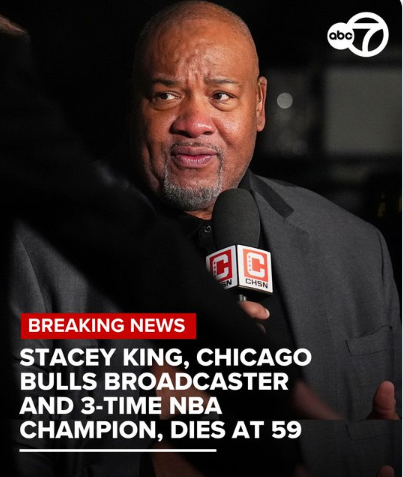
CHICAGO — The vibrant, unmistakable voice that defined modern Chicago basketball has gone silent. Stacey King, the three-time NBA champion who seamlessly transitioned into one of the most beloved and energetic broadcasters in professional sports history, has died. He was 59 years old. The Chicago Bulls organization announced the heartbreaking news on Sunday, June 7, 2026, confirming that King had suddenly passed away over the weekend. His passing leaves an unfillable void in the hearts of generations of fans who welcomed his booming laugh, infectious enthusiasm, and iconic catchphrases into their living rooms for over two decades.
For a city that holds its sports heroes in the highest regard, the news of his death was a profound shock. From the moment the announcement was made, a collective wave of grief washed over the sports world. As fans desperately searched the news to learn what happened to the larger-than-life personality, the reality of his sudden absence began to set in.
A Sudden Farewell: Understanding the Tragedy
When a figure as vibrant and seemingly indestructible as King suddenly leaves us, the immediate public reaction is often one of disbelief. In the hours following the team’s official announcement, social media platforms were flooded with questions regarding how he died. Initially, the Bulls’ statement did not specify a medical reason, focusing instead on celebrating his monumental impact and offering condolences to his grieving family.
However, as the day progressed, reports began to surface regarding the tragic circumstances of his sudden passing. Prominent Chicago sports media figures, including ESPN 1000 host David Kaplan, reported that the beloved commentator had suffered a devastating, fatal fall at his home. While an official autopsy report outlining the exact medical cause of his passing has yet to be formally released to the public, the consensus among close friends and sports insiders is that the fatal accident occurred at his residence. This abrupt end to such a vibrant life only deepens the tragedy for a community that felt so intimately connected to him.
The outpouring of emotion was immediate and overwhelming. On platforms like Twitter, the timeline was completely dominated by fans sharing their favorite audio clips of his legendary broadcast calls. Over on community forums like Reddit, long-time supporters swapped stories of meeting him at local events or simply bonding with their own children while listening to his commentary. The universal sentiment was clear: Chicago had not just lost a former player; they had lost a member of their extended family.
The Making of a Champion: From Oklahoma to Chicago
Long before he was making viewers laugh from the broadcasting booth, Ronald Stacey King was a formidable force on the hardwood. Born in Lawton, Oklahoma, King possessed a natural athletic gift that became apparent during his high school years. He chose to stay close to home for his college career, committing to the University of Oklahoma, where he blossomed into a national superstar under head coach Billy Tubbs.
During his senior season in 1988-1989, King was an absolute menace on the court. He averaged a staggering 26.0 points and over 10 rebounds per game, earning Consensus First-Team All-American honors. His dominance in the paint and his incredibly soft touch around the rim made him one of the most highly coveted prospects in the country. His impact at Oklahoma was so profound that the university later formally retired his jersey in a heartfelt ceremony, cementing his legacy in Sooners history.
Entering the 1989 NBA draft, King was viewed as a franchise-altering talent. The Chicago Bulls, a team steadily building a championship foundation around a young phenom named Michael Jordan, selected him with the sixth overall pick. The expectations were sky-high, and King stepped directly into the intense, high-pressure crucible of a team desperately chasing a title.
His arrival in Chicago coincided with the dawn of the greatest dynasty in modern basketball history. Under the guidance of head coach Phil Jackson, King provided crucial frontcourt depth, rebounding, and interior scoring off the bench. While his individual professional stats—averaging 6.4 points and 3.3 rebounds over his career—did not mirror the astronomical numbers of his college days, his contribution to the team’s ultimate success was undeniable. Playing alongside Jordan and Scottie Pippen, King was an instrumental piece of the roster that captured three consecutive NBA Championships in 1991, 1992, and 1993.
Midway through the 1993-94 season, King was traded to the Minnesota Timberwolves, beginning a journey that would see him suit up for the Miami Heat, Boston Celtics, and Dallas Mavericks before retiring from playing in 1997. While his days in a Bulls uniform had ended, his connection to the city was far from over.
The Second Act: Finding His True Voice
After his playing days concluded, King briefly explored the coaching ranks, eventually leading the Rockford Lightning to the CBA Finals in 2002. However, it was a pivot to television that would ultimately define his enduring legacy and significantly boost his net worth.
King joined the Bulls’ broadcasting team in the mid-2000s, initially serving as a studio analyst before moving to the color commentator chair. It was a revelation. Unshackled from the physical demands of the game, King’s massive personality exploded through the microphone. He didn’t just analyze the game; he felt it, he lived it, and he invited the audience to experience that unbridled joy alongside him.
He was incredibly famous for his encyclopedic memory, his sharp basketball intellect, and his unparalleled ability to coin nicknames that immediately stuck in the cultural lexicon. Phrases like “Gimme the hot sauce!” and “Did you not get the memo?” became rallying cries for an entire generation of Bulls fans. He had a unique ability to make a Tuesday night regular-season game in January feel like Game 7 of the NBA Finals. Even when the team struggled through rebuilding years, fans tuned in just to hear what “Stacy” (as fans affectionately spelled it on posters) would say next.
Bulls Chairman Jerry Reinsdorf perfectly encapsulated King’s impact in a statement following his passing: “His connection to Chicago, the Bulls and our fans spanned more than three decades — first as a player and later as the unmistakable voice that helped bring Bulls basketball into the homes of generations of fans. We will miss him deeply and remember the joy, energy, humor, candor, and passion he brought to our organization.”
The Man Behind the Microphone
While his public persona was loud, bombastic, and endlessly entertaining, those who knew him best remembered him as a deeply loving, grounded family man. Behind the larger-than-life broadcaster was a devoted husband and father.
King married his beautiful wife, Debi in a stunning 2017 ceremony. Though she maintained a relatively private profile away from the glaring spotlight of her husband’s fame, friends noted that she brought an immense sense of peace and happiness to his life. Furthermore, King was a fiercely proud father to his four sons: Erick, Garrett, Brandon, and Mason. He frequently took to social media to express his profound love and pride for his boys, viewing his role as a father as his greatest, most important achievement.
In a touching 2014 social media post, he shared a photo of himself with his older boys, marveling at the journey of fatherhood that began when he was just a young man from Oklahoma. He wrote openly about the absolute joy of being a dad, calling it “the best job in the world.” Just weeks before his tragic passing, he posted a highly emotional tribute to his late mother, reflecting on the enduring lessons she taught him—lessons he diligently tried to pass on to his own children.
An Enduring Legacy
As the city of Chicago and the broader basketball community grapple with the reality that King died, leaving a massive hole in the sports landscape, the focus naturally shifts to his enduring legacy. He was a champion on the court, but more importantly, he was a champion of the people. He possessed a rare, authentic ability to make every fan feel seen, valued, and entertained.
The tragic nature of his passing—a sudden, terrible accident—serves as a brutal reminder of the fragility of life. Yet, the overwhelming wave of love and gratitude pouring out from every corner of the sports world is a beautiful testament to a life exceptionally well-lived.
Stacey King may have passed away, but his booming voice will forever echo in the rafters of the United Center, and his joyous spirit will remain eternally woven into the fabric of Chicago basketball history.